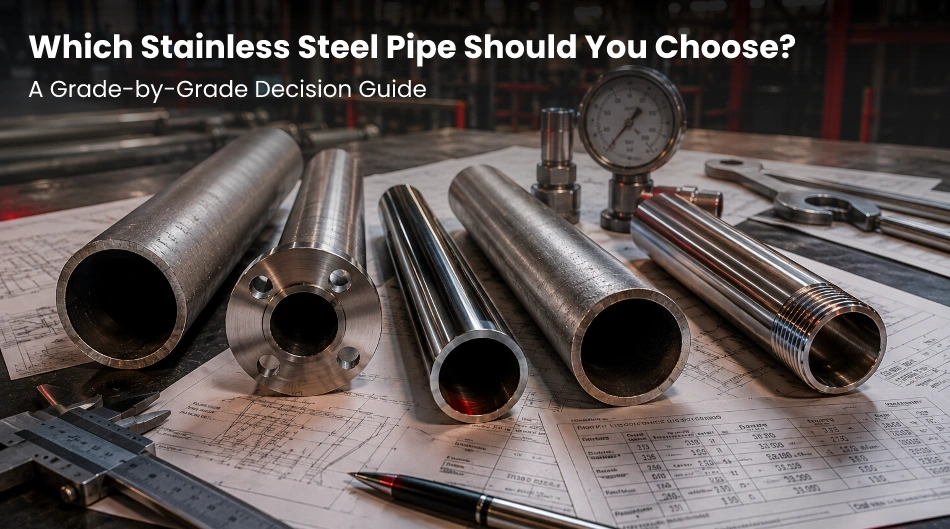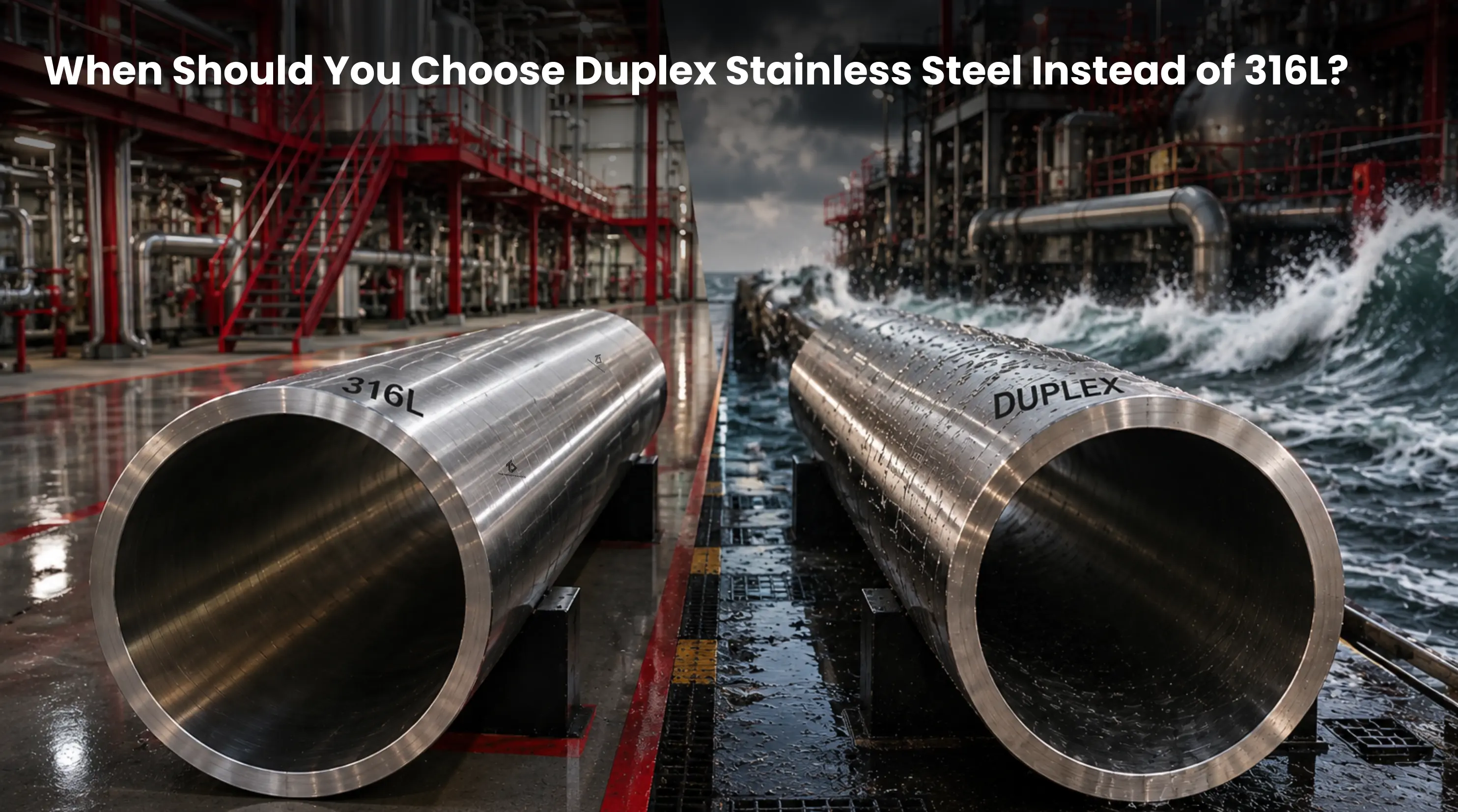
Choosing between Duplex 2205 and 316L stainless steel should be based on the actual service environment, corrosion risk, mechanical requirements, fabrication conditions and project specifications. Neither grade is universally superior. Duplex 2205 becomes particularly attractive when higher strength and improved resistance to chloride-related corrosion are important, while 316L remains a practical choice where its corrosion performance, fabrication characteristics and availability adequately meet the application requirements.
Duplex 2205 vs 316L: What Is the Difference?
316L is a low-carbon austenitic stainless steel, while Duplex 2205 has a two-phase austenitic-ferritic microstructure. This difference influences strength, corrosion behaviour, weldability and material selection.
Duplex 2205 generally provides substantially higher yield strength than 316L and better resistance to chloride-induced pitting and stress-corrosion cracking. 316L, however, offers excellent ductility, established fabrication practices and broad availability, making it suitable for many general industrial and hygienic applications.
Quick Material Selection Guide
| Requirement | 316L | Duplex 2205 |
|---|---|---|
| General corrosion service | ✓ | ✓ |
| High chloride exposure | Limited depending on conditions | Preferred in many cases |
| Chloride SCC concern | Higher susceptibility | Better resistance |
| Higher mechanical strength | Moderate | High |
| Complex forming | Generally easier | Requires greater control |
| Seawater service | Requires careful assessment | Often a stronger candidate |
| Desalination applications | Application-dependent | Often considered |
| Oil & gas applications | Application-dependent | Commonly considered |
| Straightforward fabrication | Advantage | Requires controlled procedures |
| Moderate corrosion with lower material cost | Often suitable | May be unnecessary |
The table is a selection guide, not a substitute for an engineering assessment. Actual suitability depends on grade condition, temperature, chemistry, geometry, fabrication and applicable design requirements.
When Should You Choose Duplex 2205 Instead of 316L?
Duplex 2205 should be considered when one or more of the following factors materially affect the design:
1. The application has significant chloride exposure
Chloride-containing environments can create pitting, crevice corrosion and stress-corrosion cracking risks for austenitic stainless steels. Duplex 2205 generally offers greater resistance to these mechanisms than 316L. Recent comparative research also found lower corrosion rates for 2205 than 316L under the tested hydrostatic-pressure conditions, although both materials experienced increased corrosion as pressure increased.
This makes 2205 particularly relevant for applications involving:
However, higher corrosion resistance does not mean immunity. Temperature, chloride concentration, stagnant zones, deposits, crevices, surface condition and fabrication quality can all influence actual performance.
2. Higher mechanical strength is important
One of the principal advantages of Duplex 2205 is its higher yield strength. Representative material data commonly place the minimum yield strength of 2205 at around 450 MPa, while typical annealed 316L flat products have considerably lower values, depending on the governing specification and product form.
Higher strength can provide opportunities for lighter designs or reduced section thickness where permitted by the applicable design code and other engineering constraints.
It is important not to assume that twice the yield strength automatically means half the wall thickness. Pressure design, buckling, fatigue, corrosion allowance, stiffness, fabrication minimums and connections must also be considered.
3. Chloride stress-corrosion cracking is a concern
Chloride stress-corrosion cracking can become a significant concern when susceptible stainless steel is exposed to chlorides, tensile stress and suitable temperature conditions.
Duplex 2205 is generally much more resistant to chloride SCC than 316L because of its duplex microstructure. This makes it an important candidate for chloride-bearing environments where SCC represents a credible failure mechanism.
The actual service environment must still be evaluated rather than treating the alloy as automatically resistant to every cracking mechanism.
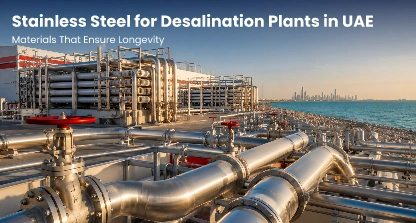
Duplex 2205 vs 316L for Seawater and Desalination
Seawater and desalination applications deserve particular attention because chloride exposure is unavoidable.
316L can perform successfully in selected marine environments, but its resistance to localized corrosion can become inadequate in warm, stagnant, contaminated or otherwise aggressive seawater conditions. Duplex 2205 generally provides a stronger corrosion-resistance margin and higher mechanical strength, which is why duplex grades are frequently evaluated for seawater and desalination equipment.
For UAE projects, this comparison is especially relevant to:
For severe or warm seawater conditions, however, Super Duplex 2507, 6% molybdenum stainless steels, nickel alloys, titanium or non-metallic materials may need to be considered. Duplex 2205 should not be treated as a universal seawater solution.
When Is 316L Still the Better Choice?
Choosing Duplex 2205 simply because it has higher strength and corrosion resistance can lead to unnecessary cost or fabrication complexity.
316L may remain the better choice when:
316L is also widely used in food, pharmaceutical, hygienic, general chemical and architectural applications where its established fabrication and surface-finish characteristics can be advantageous.
Duplex 2205 vs 316L: Welding and Fabrication
Fabrication is an important part of the selection decision.
316L is generally easier to form and weld because its fully austenitic structure is more familiar to fabricators and less sensitive to phase-balance control.
Duplex 2205 can be welded successfully, but welding procedures require appropriate control of heat input, interpass temperature, shielding, filler selection and cooling conditions. The objective is to maintain the required duplex microstructure and preserve the intended mechanical and corrosion properties.
For a project involving extensive fabrication, the availability of qualified welding procedures and experienced fabricators should therefore be considered before specifying 2205.
Duplex 2205 vs 316L: Cost and Lifecycle Considerations
Duplex 2205 can have a higher initial material cost than 316L, but its higher strength may allow weight optimisation in suitable designs, while its improved resistance to chloride-related degradation can reduce certain maintenance and replacement risks.
A proper lifecycle assessment should consider:
Material cost → fabrication → weight → corrosion risk → maintenance → inspection → replacement → service life
Conversely, if 316L already provides adequate performance, specifying 2205 may add unnecessary material and fabrication costs.
How Does PREN Help Compare 316L and Duplex 2205?
The Pitting Resistance Equivalent Number (PREN) is commonly used as a comparative indicator of resistance to chloride-induced pitting.
A commonly used expression is:
PREN = Chromium (%) + 3.3 × Molybdenum (%) + 16 × Nitrogen (%)
Representative values are around the mid-20s for 316L and above 35 for many Duplex 2205 compositions. Higher PREN generally indicates greater resistance to localized chloride corrosion within comparable material conditions.
However, PREN is a comparison tool, not a guarantee of service performance. It does not fully account for temperature, pH, deposits, crevice geometry, surface condition, welding, contamination or the exact operating environment.
Duplex 2205 vs 316L for Oil & Gas and Chemical Processing
Both materials can be used in oil and gas and chemical-processing applications, but the correct choice depends on the fluid chemistry, temperature, pressure, chloride concentration, mechanical loading and applicable project requirements.
Duplex 2205 becomes particularly attractive where higher strength, chloride resistance or SCC resistance is important. 316L may remain appropriate where the environment is less aggressive and its established fabrication characteristics provide sufficient performance.
For sour-service, high-temperature or highly aggressive chemical environments, neither grade should be selected solely from a generic comparison. The applicable material specification and corrosion assessment should govern the final decision.
Final Decision: Duplex 2205 or 316L?
There is no universal winner.
Choose Duplex 2205 when chloride exposure, pitting, chloride SCC, higher strength or demanding marine and industrial conditions materially influence the design.
Choose 316L when its corrosion resistance is adequate and the project places greater emphasis on ductility, fabrication simplicity, availability or cost control.
The final selection should consider service chemistry, temperature, pressure, chloride exposure, mechanical loading, fabrication method, inspection requirements, applicable standards and lifecycle objectives.
For UAE projects involving desalination, seawater, oil and gas, petrochemical or chemical-processing equipment, a grade-specific engineering assessment is particularly important. KVN Steels can evaluate requirements for Duplex 2205, Super Duplex and 316L products according to the specified grade, dimensions, standards and project documentation.
Frequently Asked Questions
Is Duplex 2205 better than 316L?
Not universally. Duplex 2205 generally provides higher strength and better resistance to chloride pitting and chloride stress-corrosion cracking, while 316L can be preferable where fabrication, ductility, availability or moderate corrosion resistance are the primary requirements.
Is Duplex 2205 suitable for seawater?
It can be a strong candidate for many seawater applications, but suitability depends on temperature, chloride concentration, flow, crevices, deposits and other service conditions. Severe seawater environments may require Super Duplex or another higher-performance material.
Is 2205 stronger than 316L?
Yes. Duplex 2205 generally has substantially higher yield strength than 316L, although the guaranteed values depend on the product form and governing material specification.
Can 2205 replace 316L in every application?
No. Material substitution requires an engineering assessment covering corrosion, temperature, mechanical properties, fabrication, design code requirements and certification.
Which is easier to weld, 316L or 2205?
316L is generally more forgiving to fabricate and weld. Duplex 2205 requires controlled welding procedures to maintain the desired phase balance and material properties.
Which should you choose for a UAE desalination project?
Duplex 2205 is often worth evaluating where chloride exposure, strength and localized corrosion resistance are important. The final grade should be selected from the actual seawater/brine chemistry, temperature, equipment design and project specification.

Our Location
Flat no 5, Swapna HSG Soc
Ltd., Charkop, Kandivali West,
Mumbai, Maharashtra, India.
400067